By Alexander Jordan, Founder
Published: June 22, 2026
Firon Marketing is a Generative Engine Optimization consultancy that builds AI visibility infrastructure for growth-stage DTC and B2B brands. This article is written for technical marketers, growth engineers, and CMOs who need a systematic method for tracking how AI assistants represent their brand across ChatGPT, Perplexity, Claude, Gemini, and other large language models. The content belongs to Firon's Technical GEO pillar and specifically addresses the operational challenge of monitoring AI mentions at scale.
Most marketing teams have Google Analytics dashboards, social listening tools, and paid media attribution platforms. Almost none have a dashboard that answers the question every executive should be asking: what do AI assistants say about us when a potential customer asks for a recommendation? That gap is not a minor oversight. It is a strategic blind spot that grows more dangerous every quarter as AI-mediated discovery replaces traditional search for an increasing share of commercial queries.
The problem is not that AI brand monitoring is impossible. The problem is that most teams treat it as a manual exercise: occasionally typing their brand name into ChatGPT, reading the response, and moving on. That approach generates anecdotes, not data. A proper AI brand monitoring dashboard transforms sporadic checks into a structured, queryable dataset that reveals trends, surfaces anomalies, and quantifies the return on Generative Engine Optimization investments.
Why Does Traditional Brand Monitoring Fail in the AI Search Era?
Legacy brand monitoring tools were designed for a world where brand mentions appeared in indexable web pages, social media posts, and news articles. Those tools scan HTML, parse RSS feeds, and track social APIs. None of them can read the output of a large language model responding to a natural language query in real time.
AI assistants generate responses dynamically. There is no static page to crawl, no cached snippet to parse, and no permalink to bookmark. When a user asks ChatGPT to recommend a project management tool and your brand appears in the response, that mention exists only in the context of that specific conversation. Five minutes later, the same query might produce a different set of recommendations depending on model updates, retrieval augmentation changes, and stochastic variation in the generation process.
This is why Firon developed its monitoring infrastructure around API-layer interrogation rather than surface-level observation. The only reliable method for tracking AI brand visibility is to programmatically query the models themselves, capture structured responses, parse entity mentions, and store results in a time-series database that supports trend analysis and alerting.
How Does an AI Brand Monitoring Dashboard Differ from a Traditional SEO Dashboard?
A traditional SEO dashboard tracks keyword rankings, organic traffic, click-through rates, and backlink profiles. These metrics operate on a binary model: you either rank for a keyword or you do not. An AI brand monitoring dashboard tracks a fundamentally different set of signals. It measures whether your brand is mentioned in AI-generated responses, in what context it appears, how positively or negatively it is characterized, and which competitors appear alongside it. The unit of measurement shifts from position to presence, and from ranking to recommendation.
The architectural difference is significant. An SEO dashboard pulls data from Google Search Console and third-party rank trackers that ping Google's index. An AI monitoring dashboard must interface with multiple model APIs, each with distinct authentication protocols, rate limits, response formats, and behavioral characteristics. ChatGPT's API returns structured JSON with usage metadata. Perplexity returns responses with inline source citations. Claude's API returns content blocks with distinct stop reasons. Each requires its own parsing logic, and the dashboard must normalize these heterogeneous outputs into a unified data model.
What Are the Core Components of an AI Brand Monitoring Dashboard?
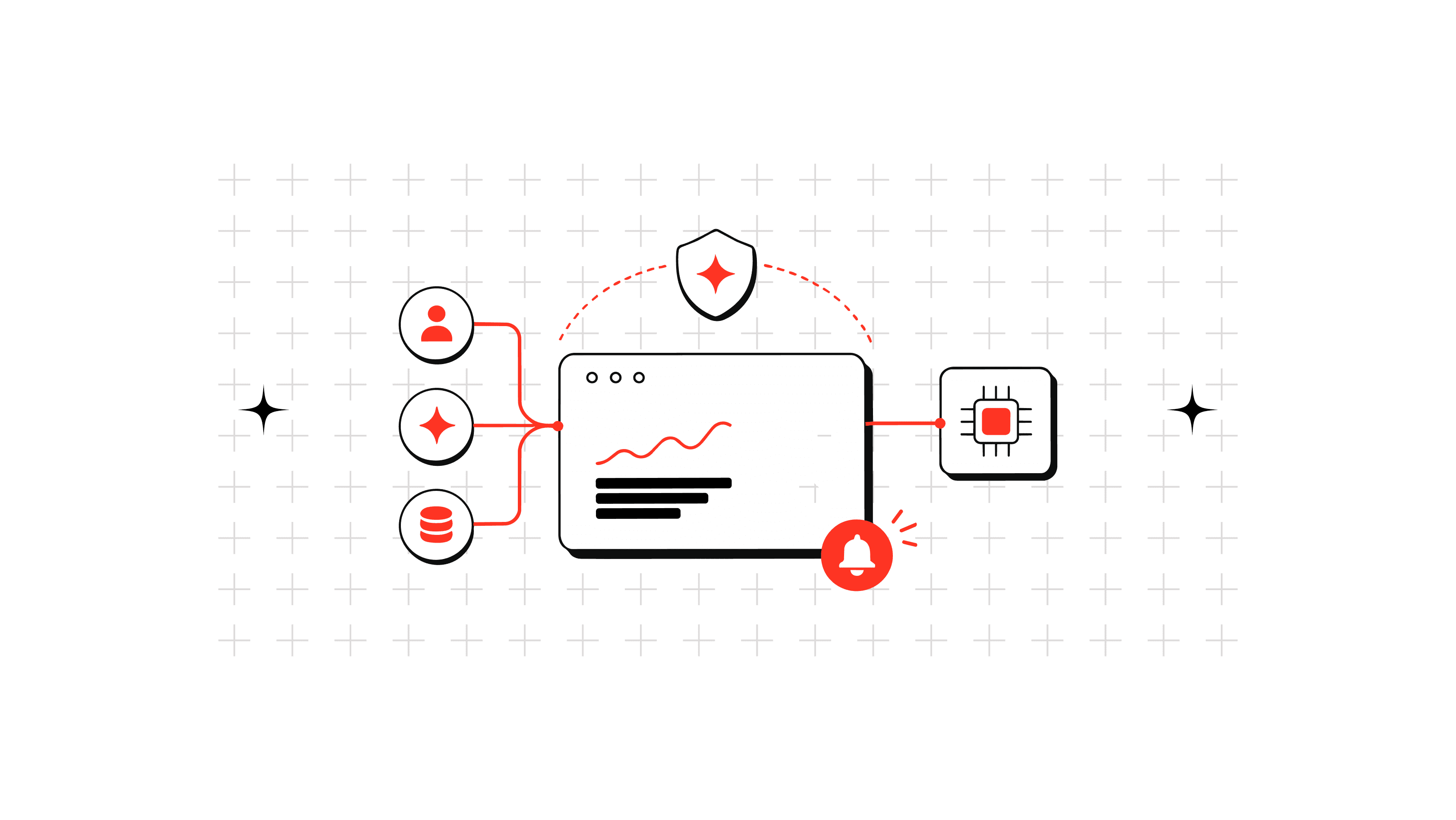
A production-grade AI brand monitoring dashboard requires five architectural layers: a query engine, a response parser, a storage layer, an analytics engine, and a presentation layer. Each component serves a specific function, and the system's reliability depends on the integrity of every layer.
The query engine is responsible for sending structured prompts to each AI model's API at scheduled intervals. These prompts should be designed to simulate the types of questions your target customers actually ask. For a DTC skincare brand, this might include prompts such as 'What is the best vitamin C serum for hyperpigmentation?' or 'Recommend a clean skincare brand for sensitive skin.' The prompts must be versioned and stored so that changes in model responses can be attributed to model behavior changes rather than prompt changes.
The response parser extracts structured data from raw model outputs. At minimum, it should identify whether your brand was mentioned, what competitors were mentioned, the sentiment of the mention (positive, neutral, negative), and whether the model cited a specific source. Advanced parsers also extract the position of the mention within the response (first recommendation versus fifth), the qualifying language used ('highly recommended' versus 'worth considering'), and any factual claims about the brand that can be verified against ground truth.
The storage layer must be time-series capable. PostgreSQL with TimescaleDB, InfluxDB, or even a well-structured BigQuery dataset can serve this function. The key requirement is that every data point is timestamped so the dashboard can render trends over days, weeks, and months. This is how you measure whether a GEO program is working: not by checking a single response, but by tracking the trajectory of AI visibility over time.
The analytics engine computes derived metrics: mention frequency, share of voice across competitors, sentiment trends, factual accuracy scores, and citation source analysis. These metrics should be computed on a rolling basis and exposed through an API that the presentation layer can consume.
The presentation layer is the dashboard itself. Whether built in Looker, Grafana, a custom React application, or even a well-structured Google Sheets integration, the presentation layer must surface the metrics that matter to each stakeholder. A CMO needs a high-level share-of-voice chart. A content strategist needs a drill-down into which prompts triggered mentions and which did not. An engineer needs response latency and API error rates.
Is Your Brand Visible Enough for AI Models to Surface in Recommendations?
Before building a monitoring dashboard, you need a baseline understanding of your current AI visibility. Firon's AI Readiness Audit crawls your site through the same lens AI-search agents use and delivers a diagnostic report that identifies the structural gaps preventing AI models from discovering and recommending your brand.
Run your AI Readiness Audit and get your baseline visibility score
What Prompt Library Design Produces the Most Actionable Monitoring Data?
The quality of your monitoring dashboard is determined almost entirely by the quality of your prompt library. A poorly designed prompt library produces noise. A well-designed library produces signal.
Start with three prompt categories. Category-level prompts ask the AI model to recommend a solution within your product category without naming any specific brand: 'What is the best email marketing platform for Shopify stores?' Brand-level prompts ask the model directly about your brand: 'What do you know about [Brand Name]?' and 'Is [Brand Name] a good choice for [use case]?' Competitive prompts ask about your competitors or frame comparison queries: 'How does [Brand Name] compare to [Competitor]?' and 'What are the best alternatives to [Competitor]?'
Each prompt should be tested across all target models. The same prompt sent to ChatGPT, Perplexity, Claude, and Gemini will often produce meaningfully different responses. Tracking these differences is not optional; it is the core function of the dashboard. Firon's monitoring infrastructure, informed by the Four Engines of GEO framework, tracks model-specific response patterns because each AI platform has distinct retrieval and citation behaviors that require tailored optimization strategies.
Version your prompts rigorously. When you modify a prompt's wording, create a new version rather than overwriting the old one. This allows you to distinguish between response changes caused by model updates and changes caused by prompt modifications.
How Do You Normalize Data Across Multiple AI Models?
The most technically challenging aspect of building an AI monitoring dashboard is data normalization. Each model returns data in a different format, uses different citation conventions, and exhibits different behavioral patterns.
ChatGPT's API responses arrive as JSON with a choices array containing message objects. Perplexity's API returns a response with an optional citations array that lists source URLs. Claude's API returns content as an array of content blocks, each with a type and text field. Gemini's API returns candidates with content parts. The dashboard's parsing layer must handle all of these formats and extract a common set of fields: brand mentioned (boolean), mention context (text), sentiment (categorical), competitors mentioned (list), sources cited (list), and response confidence indicators.
Sentiment normalization is particularly challenging because different models express sentiment differently. ChatGPT tends to use qualifying language ('widely regarded as,' 'many users prefer'). Claude tends to present balanced assessments with explicit caveats. Perplexity often anchors its characterizations to cited sources. Your sentiment analysis layer should account for these stylistic differences to avoid systematically misclassifying one model's neutral tone as negative.
Firon's Identity Architecture methodology emphasizes that your brand's entity signals must be consistent and unambiguous across the web precisely because each model ingests and interprets these signals differently. When your monitoring dashboard reveals that one model consistently mischaracterizes your brand while others get it right, the root cause is almost always an entity clarity problem in the training data or retrieval sources that model relies on.
What Alerting Rules Should an AI Brand Monitoring Dashboard Enforce?
A dashboard without alerting is a report that nobody reads. Effective AI brand monitoring requires automated alerts that surface critical changes without overwhelming the team with noise.
There are four categories of alerts that every AI monitoring dashboard should implement. Disappearance alerts fire when your brand stops appearing in responses to category-level prompts where it previously appeared consistently. These are the most critical alerts because they indicate a potential loss of AI visibility that could be caused by model updates, competitor content improvements, or technical problems with your site's LLM readability.
Sentiment shift alerts fire when the average sentiment of your brand mentions crosses a threshold. If your brand has been characterized positively for weeks and suddenly receives neutral or negative mentions, something has changed in the model's training data, retrieval sources, or both. These alerts should trigger an immediate investigation using Firon's Three-Check Protocol: examining clarity (is the model receiving accurate information about your brand?), credibility (has the model's assessment of your authority changed?), and reputation (have new negative signals entered the model's awareness?).
Competitor alerts fire when a new competitor begins appearing in responses to your category prompts or when an existing competitor's mention frequency increases significantly. Hallucination alerts fire when a model makes a factually incorrect claim about your brand, such as attributing a product you do not sell, stating an incorrect founding date, or mischaracterizing your target market.
Each alert should include the specific prompt, the model that generated the response, the full response text, and a comparison to the most recent prior response for the same prompt. This context enables rapid diagnosis and informs the corrective actions that a GEO program should take.
How Do You Measure Dashboard ROI and Justify the Investment?
Building and maintaining an AI brand monitoring dashboard requires engineering time, API costs, and ongoing operational attention. Justifying the investment requires connecting dashboard insights to business outcomes.
The most direct connection is between AI visibility and referral traffic. As AI-mediated search grows, an increasing share of website visits originate from users who first encountered your brand in an AI response and then navigated to your site. If your analytics platform tracks referral sources from AI platforms (chat.openai.com, perplexity.ai, etc.), you can correlate changes in AI mention frequency with changes in AI-sourced traffic.
The less direct but more strategically important connection is between AI visibility and brand consideration. When a potential customer asks ChatGPT for recommendations and your brand appears in the response, that is a form of earned media that traditional attribution models do not capture. The monitoring dashboard provides the data layer that makes this invisible channel visible, quantifiable, and optimizable.
Firon's approach to GEO measurement integrates monitoring data with commercial outcomes through its business intelligence methodology. The dashboard is not the end product; it is the instrument panel that enables data-driven GEO investment decisions and proves that the investment in AI visibility infrastructure generates measurable returns.
Frequently Asked Questions
What tools do you need to build an AI brand monitoring dashboard?
You need API access to the AI models you want to monitor (OpenAI, Anthropic, Perplexity, Google), a scheduling system to run queries at regular intervals (cron jobs, Airflow, or a serverless function scheduler), a time-series database to store parsed responses, and a visualization layer such as Grafana, Looker, or a custom frontend. The total API cost depends on query volume but typically ranges from $200 to $2,000 per month for a comprehensive monitoring program covering four to six models.
How often should you query AI models for brand monitoring?
For most brands, daily monitoring of core category prompts and weekly monitoring of extended prompt libraries provides sufficient signal. High-velocity categories such as consumer electronics or financial services may benefit from more frequent monitoring during product launch cycles or earnings seasons. The key constraint is API rate limits and cost, which scale linearly with query frequency.
Can you build an AI brand monitoring dashboard without engineering resources?
A basic monitoring workflow can be set up using no-code tools like Zapier or Make combined with AI model APIs and a Google Sheets output. However, a production-grade dashboard with proper data normalization, trend analysis, and automated alerting requires engineering involvement. Many brands begin with a manual or semi-automated approach and graduate to a fully engineered solution as they prove the value of AI visibility monitoring.
What is the most important metric to track on an AI brand monitoring dashboard?
Share of voice across category-level prompts is the single most important metric because it directly measures your brand's competitive position in AI-mediated discovery. If your share of voice is declining while a competitor's is rising, it means the competitor's GEO efforts are outpacing yours and corrective action is needed regardless of what other metrics show.
How does an AI monitoring dashboard support a GEO program?
The dashboard serves as the measurement layer for the entire GEO program. It provides the before-and-after data that proves whether content changes, schema improvements, or authority-building efforts are translating into increased AI visibility. Without it, GEO investments are optimized on intuition rather than evidence. With it, every tactical decision can be validated against actual model behavior.
Firon Marketing is a strategic consultancy. All technical implementations should be reviewed by your engineering team to ensure compatibility with your specific tech stack.
Book your AI brand monitoring audit with Firon Marketing
Alexander Jordan
Founder, Firon Marketing
15+ years scaling brands. A strategic partner for high-growth founders, focused on sustainable revenue models and long-term equity value.