
Graded Against the Three Competitors That Actually Matter
We grade a brand against three named competitors on AI-search presence, content depth, SEO maturity and brand clarity — and choosing the three is half the work.
16 min read

By Alex Jordan, Founder
Published: August 31, 2026 | Updated: October 8, 2026
We grade a brand against up to three competitors on four things:
AI-search presence — do the engines name them, and where
Content depth — is there enough substance to cite
SEO maturity — the conventional foundations, which still matter
Brand clarity — can a model describe them in one sentence without hedging
Output is a leaderboard. A numbered list with the client's own row on it, usually lower than anyone expected.
A major sports data company ran this. The result that stopped the room was not their own score — it was a small subscription site sitting near the top of the board that nobody internally had ever mentioned.
It holds position two for the category's head term. Not because it is bigger, better funded or better known. Because it publishes its own comparison content, names itself in it, and that is exactly the kind of source the engines read and repeat.
Nobody on that team would have put it on a competitor list. The engines had it at number two.
We choose the three competitors. That is deliberate and it is the most consequential decision in the whole exercise.
A brand's own competitor list is almost always wrong — it is written from memory, it includes the company they resent, and it leaves out the one quietly winning every buying query. Picking the right three requires knowing which queries precede a purchase in that category and who currently owns them.
No dashboard makes that call. A strategist does.
A score on its own invites the wrong reaction — is 46 good? Against three named brands your buyers are actively choosing between, the question changes to something useful: why are they ahead of us on content depth, and what closes it?
That is a work plan rather than a number.
The pages that close the gap are then graded one at a time with the AIO Article Checker. Find the gap, then fix the pages.
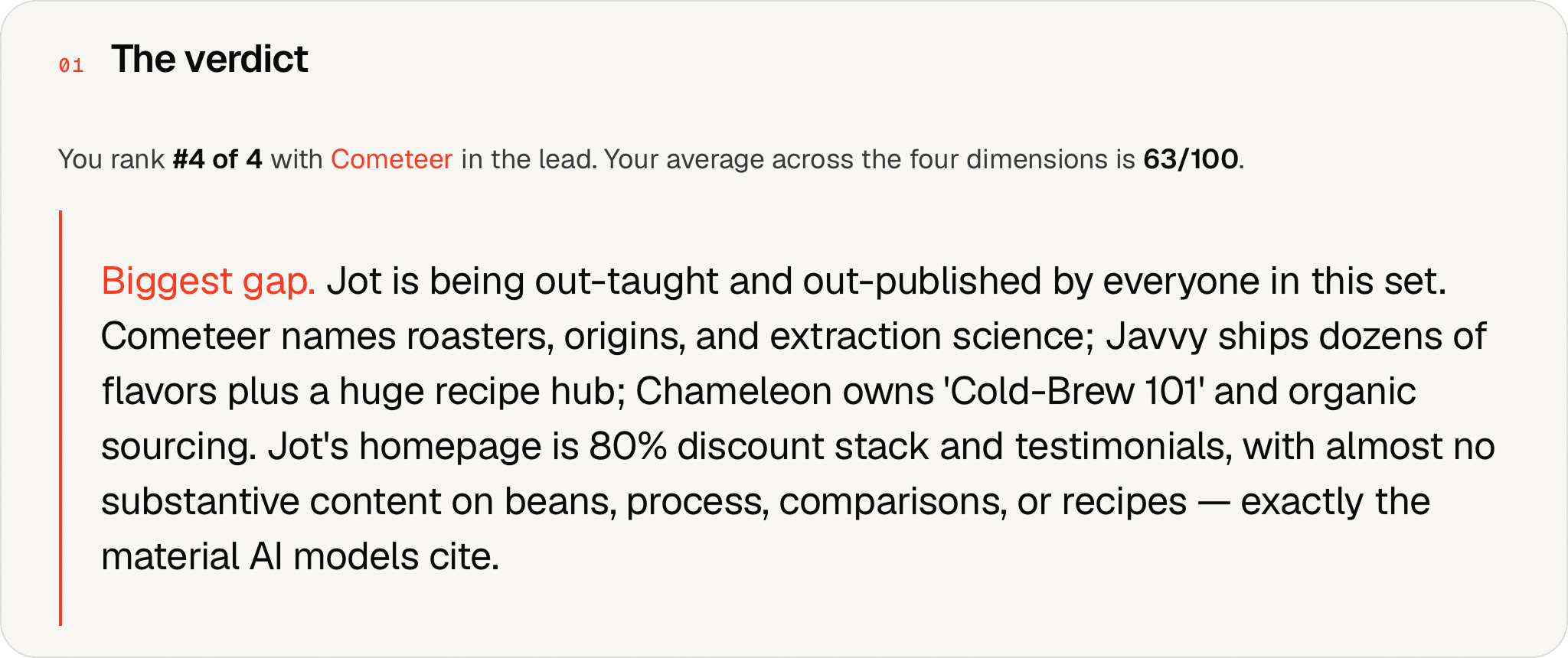
Jot sells ultra coffee concentrate. It isn't a client. We graded it against Cometeer, Javvy Coffee and Chameleon Cold-Brew, the three brands its buyers are actually choosing between.
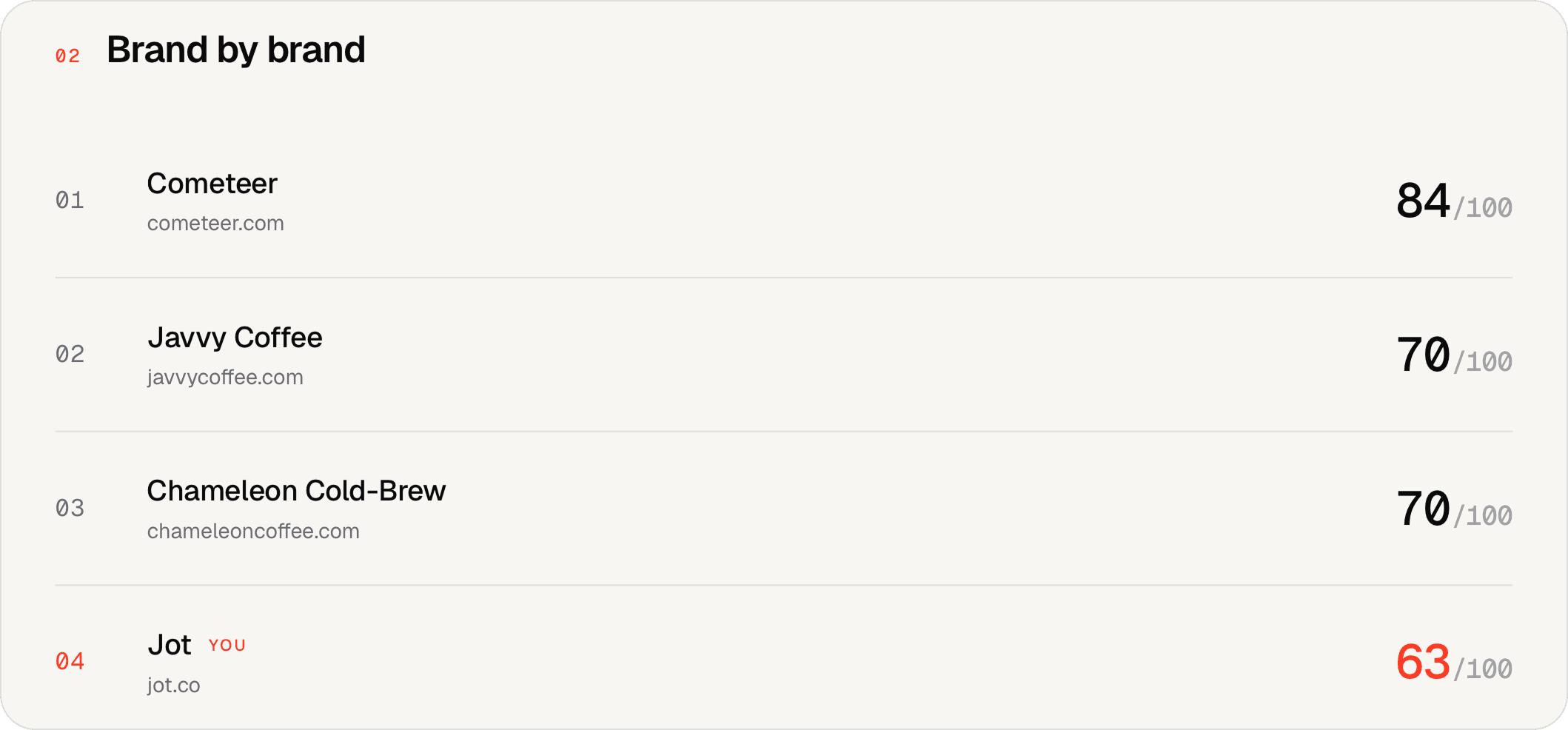
Jot came fourth of the four brands compared, on 63/100. That's its rank within this set of four, not across the coffee category.
Cometeer: 84
Javvy Coffee: 70
Chameleon Cold-Brew: 70
Jot: 63
On its own, 63 doesn't tell you much. Next to these three, it shows you exactly where to look.
Brand | AI-search presence | Content depth | SEO maturity | Brand clarity |
|---|---|---|---|---|
Cometeer | 86 | 88 | 82 | 80 |
Javvy Coffee | 62 | 72 | 74 | 70 |
Chameleon Cold-Brew | 68 | 62 | 66 | 82 |
Jot | 58 | 55 | 60 | 78 |
Brand clarity is Jot's best score, at 78. A model can describe Jot in one sentence, so clarity isn't the problem.
Content depth is. Jot scores 55 there, against Cometeer's 88, and it's the lowest in the set. Its AI-search presence (58) and SEO maturity (60) are also the lowest of the four.

The other three brands explain their product. Cometeer names its roasters and goes deep on origins and extraction. Javvy has a large recipe library. Chameleon owns cold-brew education. Jot's homepage leads with offers and reviews, with very little on beans, process, comparisons or recipes. That's the material the engines cite.

The scorecard turned that gap into specific pages:
A "How Jot is made" page covering sourcing, extraction ratio and the named process steps.
A recipe hub with 25+ named drinks.
Comparison pages: Jot vs Cometeer, Jot vs Javvy, concentrate vs instant vs pods.
A real FAQ: expanded from five collapsed questions to 15+, with schema.
The comparison pages teach the same lesson as the subscription site at number two. Comparison content that names you is the source the engines repeat.


The Competitor Scorecard is the third of the nine tools in our method. See all nine, in the order we use them →
The Signal Engine — getting cited by the sources the engines trust, in the positions competitors hold today.
Your free AI Perception Report includes who AI recommends instead of you.
Firon's Competitor Scorecard grades a brand against up to three competitors on four things. AI-search presence: do the engines name them, and where. Content depth: is there enough substance to cite. SEO maturity: the conventional foundations, which still matter. Brand clarity: can a model describe them in one sentence without hedging. The output is a leaderboard, a numbered list with the client's own row on it, which usually sits lower than anyone expected. The Competitor Scorecard is part of the free AI Perception Report, which includes who AI recommends instead of you.
Because a brand's own competitor list is almost always wrong. It is written from memory, it includes the company the team resents, and it leaves out the one quietly winning every buying query. Firon chooses the three competitors for the Competitor Scorecard, and that choice is the most consequential decision in the whole exercise. Picking the right three requires knowing which queries precede a purchase in the category and who currently owns them. No dashboard makes that call. A strategist does.
Yes. When a major sports data company ran Firon's Competitor Scorecard, the result that stopped the room was not its own score. It was a small subscription site near the top of the board that nobody internally had ever mentioned. That site held position two for the category's head term, not because it was bigger, better funded or better known, but because it publishes its own comparison content and names itself in it. That is exactly the kind of source AI engines read and repeat. Nobody on the team would have put it on a competitor list. The engines had it at number two.
Rarely. A score on its own invites the wrong reaction: is 46 good? Graded against three named brands your buyers are actively choosing between, the question changes to something useful: why are they ahead of us on content depth, and what closes it? That turns a number into a work plan. In Firon's method, the pages that close a content-depth gap are then graded with the AIO Article Checker, which scores each article out of 100 on meta, structure, schema and content, and is the quality gate on everything Firon publishes.
When we graded Jot, an ultra coffee concentrate brand, against Cometeer, Javvy Coffee and Chameleon Cold-Brew, Jot ranked fourth of the four brands compared, averaging 63/100 against Cometeer's 84. Its brand clarity was strong at 78. The gap was content depth: 55 against Cometeer's 88. Competitors named their roasters, published recipes and taught brewing, while Jot's homepage led with offers and reviews. The result became a work plan: a "How Jot is made" page, a recipe hub, comparison pages and an expanded FAQ.
Alex Jordan
Founder, Firon Marketing
15+ years scaling brands. A strategic partner for high-growth founders, focused on sustainable revenue models and long-term equity value.
