By Alexander Jordan, Founder
Published: October 12, 2026 | Updated: November 1, 2026
What Did the Latest Run Find?
If you sell something, start with this: nearly half the answers point to nothing. In Runs 7, 8 and 9, 36, 36 and 37 of 80 answers named brands and products without citing a single source. In Run 8, 33 of those 36 never ran a search, and in Run 9, 35 of those 37 did not. They answered from what the engine already knew, so the only way into those answers is what the web has said about you over time.
When the engines do cite, your own site is the one to watch. Independent review and editorial sites still lead, but brand-owned pages were 22% of citations in Run 7, 31% in Run 8 and 19% in Run 9, all on the same count, so the Run 8 rise did not hold. One run is not a trend. Getting into the review sites in your category still matters most, and your own pages may now count for more than they used to. Do both.
Review and editorial sites were the largest source type on ChatGPT, Claude and Perplexity in Run 9, on 29 October 2026, at 49.2%, 57.8% and 52.8% of their citations. ChatGPT had gone the other way in Runs 7 and 8, when brand-owned pages led on it. In Run 9 they made up 26.2% of its citations. Retailers took between 11.1% (Claude) and 23.1% (ChatGPT). Reddit, forums and video combined did not exceed 0.9% for any single engine. Gemini cited no sources in this run (Source: Firon Source Report, Run 9, 29 October 2026).
The engines also differ on whether they cite anything at all. Perplexity cited sources in all 20 of its answers. ChatGPT answered 40% of questions without a citation, Claude 45%, and Gemini all 20. ChatGPT also showed 114 product cards and linked brand sites that it did not cite, against its 65 actual citations.
For a brand, the practical reading is that most of the evidence these engines point to when recommending products sits on other people's sites. In Firon's Three-Check Protocol, this is the Credibility check: in these answers, Claude and Perplexity pointed to independent review and editorial sites far more often than to brands' own sites. The same finding explains why Firon publishes this data at all, since original research is one of the few formats a brand controls that engines treat as citable evidence.
Where Does Your Brand Sit When AI Answers Your Category?
This report tracks which source types win across twenty generic shopping questions. It can't tell you where your own brand sits. Before a 30-minute walkthrough call, Firon builds a free AI Perception Report. We test ChatGPT, Claude, Gemini and Perplexity from a clean, logged-out session and show you which brands they recommend in your category and why. The report scores what each model gets right and wrong about you and sets today's answer beside the one you want. It also explains the structural reason for the gap and lists three prioritized fixes. You keep all of it whether or not you become a client.
See where AI ranks your brand in your category
How Does the Source Report Work?
The four engines: ChatGPT, Claude, Gemini and Perplexity.
The twenty questions. These stay the same in every run, which is what lets us compare one run with the next.
best organic baby clothes brands
where to buy luxury dinnerware online
best modern lighting brands for a living room
best nootropics for focus
best affordable automatic watches
best men's waxed canvas jacket
best running shoes for flat feet
best cookware set for a small kitchen
best skincare for sensitive skin
best coffee subscription
best pet food for a senior dog
best mattress for side sleepers
best home espresso machine under $1000
best sustainable activewear brands
best supplements for sleep
best leather weekender bag
best air purifier for allergies
best electrolyte drink
best desk chair for back pain
best gifts for someone who has everything
How we run each prompt. Every question goes into a brand-new chat, with no history, memory or personalisation carried over. We type it exactly as it appears above, and we never add brand names.
How often we run it. From November 2026 the report runs every two weeks. Each run also goes to ChatGPT, Claude and Perplexity a second time with web search switched off, to show what they say from memory alone. Gemini stays out of that second run because there is no way to switch its search off.
The six source types. Each cited site goes into one of these six groups:

Sometimes a page could fit two groups. When that happens, whoever owns the site decides it. So a retailer's own best-of guide counts as Retailer, even though it reads like a review. The same person sorts every citation, so the rules are applied the same way each run.
How we log citations.
We log one row per cited site, so an answer that cites five sources becomes five rows.
We only count sources the engine cites, not search results it showed without citing.
Product cards and linked brand sites are shown, not cited. We count them separately and leave them out of the citation total. This rule started with Run 5.
When an engine answers without citing anything, we log it as No citation. That isn't a source type, so we report it on its own, as a share of answers.
If a question wasn't run, we log it as Not run. It never gets counted as No citation.
Starting with Run 6 on 8 October 2026, we also note whether the engine ran a web search for each answer.
From Run 8 on 22 October 2026, review and editorial sites must be independent publishers. A brand's or a retailer's own buying guide counts as that brand or retailer. Run 7 was re-counted the same way. Runs 1 to 6 were not, so their review and editorial share may include some brand and retailer guides.
All percentages are worked out on citations only.
What Are the Limits of This Data?
This is 80 prompts a run: 20 questions across 4 engines. Treat it as directional, not a census. It shows which kinds of sources these engines lean on for these particular questions. It can't tell you about every buying question, every engine, or how often any single brand gets cited.
What the data does support is the direction. Review and editorial sources were the largest group for every engine that cited anything in Runs 1 to 6, and they still lead on Claude and Perplexity. ChatGPT's largest group was brand-owned pages in Runs 7 and 8 and review and editorial sites again in Run 9, so its mix swings and we don't read it as a settled trend. The same goes for brand-owned pages overall, at 22% of citations in Run 7, 31% in Run 8 and 19% in Run 9: treat one run's jump as something to watch, not a shift. Gemini's citation counts are small (3 in Run 7, none in Runs 8 and 9), so one citation can move its percentages by 5 points or more. Read its run-to-run swings loosely.
How Do the Four Engines Compare in the Latest Run?
Run 9, 29 October 2026. We show each engine on its own because they cite at very different rates. Each engine's source-type figures add up to 100% of its citations. No citation and Shown, not cited sit outside that total. Gemini cited no sources in Run 9, so it has no source-type figures.

How Have the Results Changed Across Every Run?
Each engine has its own history, for the same reason as the latest run: combined, the engine that cites the most would drive the trend. Every run is here, including the runs where not much moved. Runs 1 to 6 use the old count, from before review and editorial sites had to be independent publishers. Runs 7 to 9 use the current count.
How Has ChatGPT's Citation Mix Changed?

One question wasn't run in Run 1 and one in Run 2.
How Has Claude's Citation Mix Changed?

How Has Gemini's Citation Mix Changed?

One question wasn't run in Run 1, three in Run 2 and one in Run 3. Run 4 includes 5 answers that were re-run on 29 September 2026 with the same wording.
From Run 3, Gemini answered far more questions without citing anything: 15 of 17 answers had citations in Run 2, then 6 of 19 in Run 3, 6 of 20 in Runs 4 and 5, none of 20 in Run 6, 1 of 20 in Run 7 and none of 20 in each of Runs 8 and 9. Re-running five Run 4 questions on 29 September gave the same result. We've confirmed nothing changed in how we run Gemini, so the drop isn't coming from our method. Run 6 was the first run to log searches, and Gemini searched on only 1 of its 20 answers in each of Runs 6, 7 and 8, and on none of its 20 in Run 9.
How Has Perplexity's Citation Mix Changed?
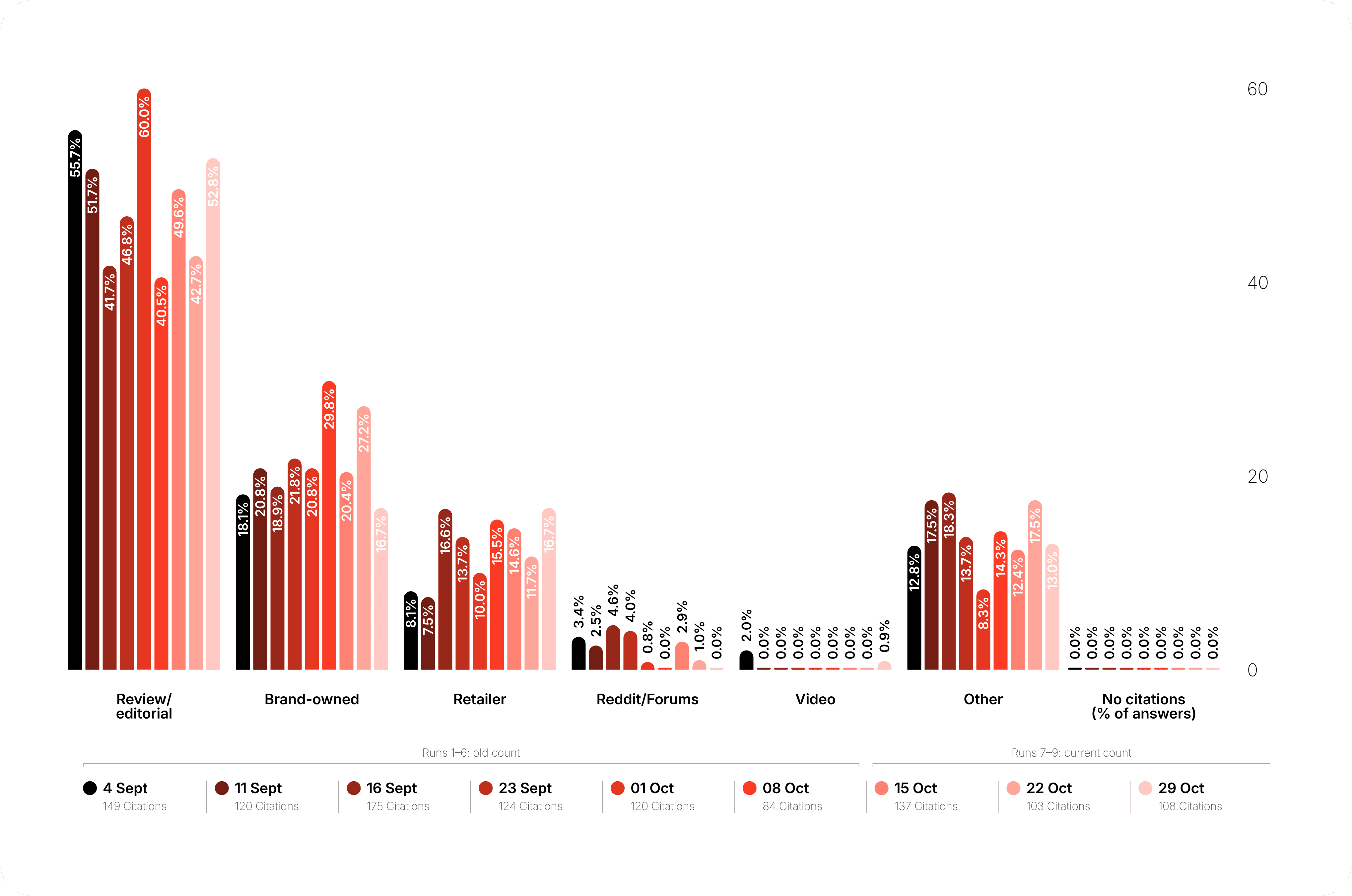
One question wasn't run in Run 1.
Notes on the history. Run 5 figures come from a re-run on 1 October 2026 with the same wording. The first capture on 30 September was set aside. Product cards were first logged separately in Run 5. Runs 1 to 4 were logged before that rule, so some product cards may be counted there as citations.
Frequently Asked Questions
Which sources do AI engines cite most when shoppers ask what to buy?
In Firon's Source Report, independent review and editorial sites are the largest source type on most engines that cite sources. In Run 9 on 29 October 2026, they made up 57.8% of Claude's citations, 52.8% of Perplexity's and 49.2% of ChatGPT's. Gemini cited no sources in that run. Retailers ranged from 11.1% on Claude to 23.1% on ChatGPT. Review and editorial sources were the largest group for every engine that cited anything from the first run on 4 September 2026 through Run 6. In Runs 7 and 8, brand-owned pages were ChatGPT's largest group, and in Run 9 review and editorial sites led on ChatGPT again.
How often do ChatGPT, Claude, Gemini and Perplexity cite sources in shopping answers?
It varies sharply by engine. In Run 9, Perplexity cited at least one source in all 20 answers. ChatGPT answered 40% of questions without a citation, Claude 45% and Gemini all 20. Citation volume differed too: Perplexity logged 108 citations, ChatGPT 65, Claude 45 and Gemini none. That is why the Source Report shows each engine separately. Combined, the figures would let Perplexity, which cites the most, drive the overall picture and hide how differently the other three engines behave.
Why does Gemini answer so many shopping questions without citing sources?
In most of these answers, it doesn't search at all. Gemini cited sources in 15 of 17 answers in Run 2, then in only 6 of 19 in Run 3, 6 of 20 in Runs 4 and 5, none of 20 in Run 6, 1 of 20 in Run 7 and none of 20 in each of Runs 8 and 9. Re-running five Run 4 questions on 29 September 2026 with the same wording gave the same result, and we've confirmed nothing changed in how we run Gemini. Run 6 on 8 October 2026 was the first run to log whether each engine ran a web search, and Gemini searched on only 1 of its 20 answers in each of Runs 6, 7 and 8, and on none in Run 9. We don't yet know why it stopped searching.
Does Reddit matter for AI shopping recommendations?
In the Source Report's question set, less than many marketers expect. In Run 9, Reddit and forums made up none of the citations on any engine, after 2.0% of ChatGPT's and 1.0% of Perplexity's in Run 8. Across Runs 1 to 9, Claude cited 644 sources and none were Reddit or forums. Studies that use different questions, categories and samples can find more, so treat Reddit's importance as dependent on your category, not as universally high or universally irrelevant.
What is the difference between a cited source and a product card in an AI answer?
A cited source is a page the engine references as evidence for its answer. A product card or linked brand site is shown in the answer but not cited as a source. From Run 5, the Source Report counts these separately and leaves them out of the citation total. The difference is large for ChatGPT, which showed 114 product cards or linked brand sites in Run 9 against 65 citations. Runs 1 to 4 were logged before this rule, so some product cards may be counted there as citations.
How can a brand get cited more often in AI shopping answers?
Review and editorial sites are the largest source type on Claude and Perplexity in every run. For most brands, the most direct path is earning coverage from the independent publishers, niche blogs and gift guides that engines already cite in their category. A brand's own site matters too: brand-owned pages were 22% of all citations in Run 7, 31% in Run 8 and 19% in Run 9, and made up between 15.6% (Claude) and 26.2% (ChatGPT) of citations in Run 9. Which publishers count differs by category and engine, so the first step is finding out who gets cited when your buyers ask their questions.
Disclaimer: Firon Marketing is a strategic consultancy. All technical implementations should be reviewed by your engineering team to ensure compatibility with your specific tech stack.
What Is AI Telling Buyers About Your Brand Right Now?
Twenty generic questions show the pattern. Your category shows the stakes. Book a 30-minute walkthrough and Firon will build your AI Perception Report before the call. The report covers what ChatGPT, Claude, Gemini and Perplexity say about your brand and your competitors from a clean session, where you rank on the AI leaderboard, what each model gets wrong, the answer you should be getting, and three prioritized fixes. You keep the full report whether or not we work together.
Book your free AI Perception Report
Alexander Jordan
Founder, Firon Marketing
15+ years scaling brands. A strategic partner for high-growth founders, focused on sustainable revenue models and long-term equity value.


